Discontinued appliance part? When a copy makes sense
A printed oven knob sounds like a smart fix until the oven’s on.
Short answer
3D printing replacement home appliance parts can make sense for a cool, low-stakes piece such as a cover, a shelf clip or a knob away from heat, but never for a part that touches heat, mains power, gas, a water line or food. Ask the maker for the original part first. LOUEI 3D PRINT says no to parts that need a certification it does not hold.
What does it touch?
A copy of an appliance part makes sense only when the part touches no heat, mains power, gas, drinking water or food, and its failure cannot change what the appliance does.
The table sorts appliance parts by what they touch, because that, not the fit, decides whether a copy is a fair idea. Fit and safety are two checks: a copy can match the old part exactly and still be the wrong plastic for the heat, power, water or food behind it.
Read it from the top. The never rows hold for any maker and any shop; the last row is the only place a copy makes sense.
| What it touches | For example | Copy it? | Why, and what instead |
|---|---|---|---|
| Heat | An oven knob, or any part near a burner, element or hot air | Never. | Plastic near heat can soften or warp; get the maker’s part through a dealer. |
| Gas | Any part of a gas appliance, from a valve to a flame knob | Never. | In BC a gas appliance needs a certification mark, and gas work is for licensed people. |
| Mains power | A part round wires, plugs, switches or a motor inside the panel, or a housing over them | Never. | In BC electrical equipment needs a recognized certification mark, and electrical work is for licensed people. |
| Water or food | A hose fitting, a part in the drinking-water path, a blender or container part | Never. | A leak does damage; drinking-water materials should carry an accredited mark; no food-contact approval is implied by a printed part. |
| Its failure changes what the machine does | A door latch, a lid lock or a child lock | Never. | The part decides what the machine does, so get the maker’s part through a dealer. |
| Nothing hot, live, wet or eaten | A cover, trim piece, shelf clip, a vacuum’s crevice tool, or a pull-off knob on a plastic shaft that stays cool | A copy can make sense. | If it fails, it is a nuisance, not a hazard; still run the three checks below. |
Is the appliance part really discontinued, or am I searching wrong?
Check three things before you call it gone: the appliance’s model number, the part in the maker’s parts diagram for that model, and whether the old part number now points to a newer number or a larger kit.
One maker’s own support page says a part it no longer makes may still sit with an authorized parts distributor, or turn up used or refurbished when you search the part number. One print shop’s guide adds that an old number can quietly point to a whole assembly instead of the one small piece. If every route is dead, a copy is the last step, not the first, and only for a part in the table’s last row.
Is it safe to 3D print appliance parts?
It depends on what the part touches: a copy can be reasonable for a part that stays cool and carries no power, gas, water or food, and it is the wrong answer for anything else.
Ask two questions about your part. Does it get hot, carry power, or touch gas, water or food? Could its failure change what the machine does? A yes to either means the maker’s part or a licensed trade, not a copy.
In BC, a gas appliance must carry a certification mark to be sold, installed or used, and electrical equipment must carry a recognized certification or approval mark. Most gas and electrical work there is for licensed people. A copied plastic part inside either is a change no one has approved.
Health Canada says materials that touch drinking water are not regulated nationally and recommends an accredited certification mark, which a printed copy does not carry. No Canadian food-contact approval is implied by a printed part. This is general information, not legal advice.
If a copy of an appliance part fits, is it safe to use?
Not necessarily: a good fit shows that the shape is right, not that the material is right for the heat, water, food or load the part meets in use.
A filament-printed part is built in layers and is usually weaker across them than along them, so it may not behave like the molded original. Judge a copy by what the part does and what it touches, not by how well it snaps on.
- Fit: the shape, the size and the clips; a copy can pass this and still be wrong.
- Touch: does it ever get warm, wet, live or touch food?
- Failure: if it breaks, does the machine do anything differently?
Will a copied part void my warranty or make me liable?
That depends on your warranty’s own terms and on your insurer, so ask the maker and your insurer before you fit a copy; this is general information, not legal advice.
If the appliance is still under warranty, ask the maker for the part first: that is what the warranty is for. If a part you fitted fails and does damage, ask your home insurer how that would be treated.
BC law sets baseline quality terms for goods sold to consumers, and in a retail sale a seller cannot contract out of them. Whether that reaches a copied or made-to-order part is a question for Consumer Protection BC or a lawyer.
Can you 3D print a replacement knob for an old washer or dryer?
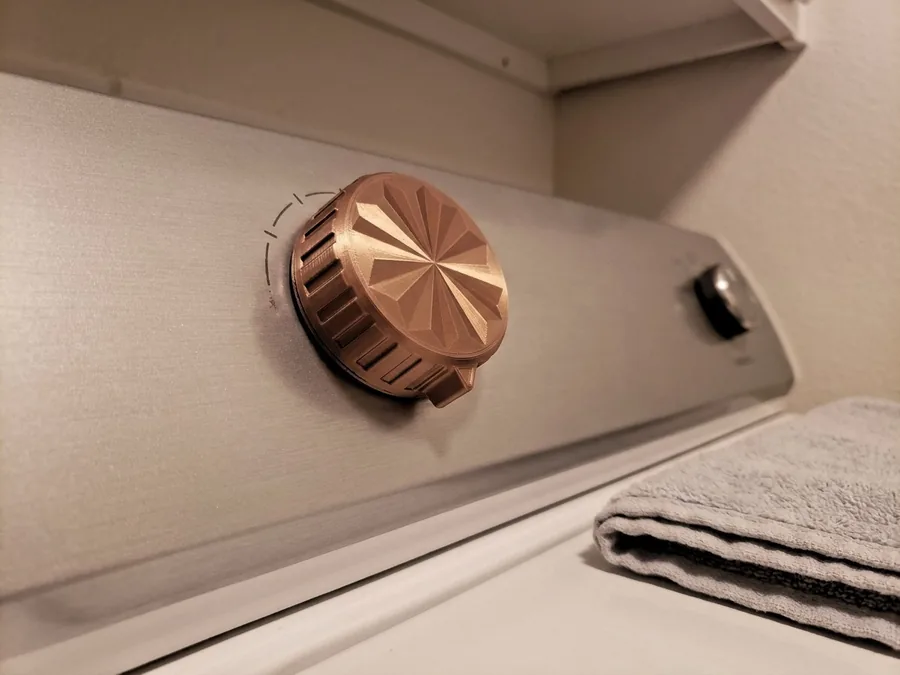
It can make sense only if the knob pulls off the front panel, stays cool in use and pushes onto a plastic shaft; not if it sits on a metal shaft, is part of the switch, sits on a gas dryer, or can only be reached by opening the panel. When you are not sure, the table’s mains row applies: get the maker’s part.
Look inside the old knob before you send anything, then take these photos: the shaft hole straight on, with any flat, ridge, clip or spring inside it; the knob from the side, so its depth shows; and the bare shaft on the machine, from the front and from the side, with a ruler beside it. The same reading works for any cool part, such as a vacuum’s crevice tool: a plain nozzle with no motor, cord or switch in it.
- The collar: the round end that slides onto the wand or hose; photograph it beside the part it fits.
- The crack: photograph it close up, from both sides; it shows where the part gave.
- The inner ridge: the small step inside the collar that holds it on; it is easy to miss in a photo.
- The flat nozzle: the working end; photograph its whole length and its narrow tip beside a ruler.
A photo with a ruler and the part it fits says more than the model number alone.
If your part is on the cool side of the table, you can ask LOUEI 3D PRINT for a copy of a cool, low-stakes part made from the broken piece. A photo is enough to start: a person reads it and replies within one business day, and says so plainly if the part cannot be copied; the review is free.
Before you contact any shop
Have these ready. Any shop will ask for most of them.
- Photos: the whole part on plain paper, the same view with a ruler beside it, and the break up close.
- The sizes you can measure, and what the part fits onto or into.
- Where the part lives and what it does.
- How many you need.
- Any file or drawing you have, even an old one.
At LOUEI 3D PRINT you can start from anything: an idea, a sketch, a photo, CAD, measurements, the broken part itself or a previous order. We read STEP, STL, OBJ, IGES, DXF, PDF drawings and photographs.
When this is not a job for a shop
- A part for a gas appliance: in BC, a gas appliance must carry a certification mark to be sold, installed or used.
- A part that carries, switches or covers mains power: in BC, electrical equipment must carry a recognized certification or approval mark, and most electrical work is for licensed people.
- A part in the drinking-water path: Health Canada recommends looking for the certification mark of an accredited body.
Some parts cannot be reproduced: parts that are badly damaged, parts with missing geometry, and parts that need a certification we do not hold.
Written by the LOUEI 3D PRINT team. LOUEI 3D PRINT makes custom and replacement parts: 3D scanning and reverse engineering, FDM and resin 3D printing, molding and casting. Serving North America.