Small run of parts without paying for an injection mold
Twenty copies: print it twenty times, or pour twenty from one silicone mold?
Short answer
The usual alternatives to injection molding for small run parts are printing each copy or pouring copies from one silicone mold. Choose by whether copies must start from one shape, what the part does and how it is shaped, not by a quantity line. LOUEI 3D PRINT prints in FDM and resin and pours resin, plaster and cement in silicone tools.
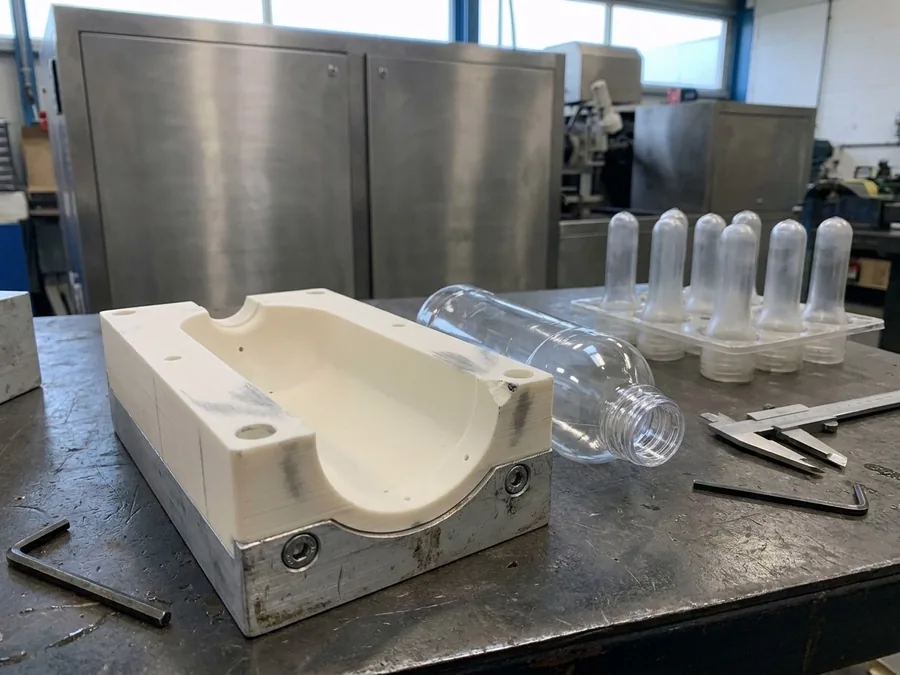
The route chooser
Five plain questions about your part, not a price or a count, point a small run to printing each copy, pouring copies from a silicone mold, or asking a mold shop.
You are right to balk at the mold. An injection mold is a tool made once and paid for before the first part, and its cost is spread over the parts it makes, so on a small run each part carries a large share of it. Published studies put the point where a mold pays off in very different places, depending on the part, so this chooser uses no count or price line.
Read down the first column for what is true of your part, then across to the three routes. There is more on weighing print against cast for your copies. At LOUEI 3D PRINT, a project can start from the part itself, a photo, a sketch or measurements.
| Your part | Print each copy | Pour from a silicone mold | Ask a mold shop |
|---|---|---|---|
| Every copy must start from one shape | Each copy is its own run, so small differences between copies are normal. | Every copy follows the same cavity, which follows one master. | A hard mold repeats one shape over a very long run. |
| The design may still change | Change the file and print again; nothing else has to be remade. | A change to the master means making a new mold. | A change after the mold is cut is hard to make. |
| Hollow inside, or a hook that locks in | Often possible, because no mold has to let go of the part. | Soft silicone can flex around some shapes; ask before you plan on it. | One parts vendor says each shape that locks in needs extra moving parts in the mold. |
| It must carry real heat, load or a snap fit | Strength changes with the direction of the layers; try one first. | Cast resin is not the production plastic; try one first. | The usual route when the part must be made in the production plastic. |
| You need very many that must stay the same | The work repeats for every part. | The mold wears, so one mold does not last for ever. | Its cost is spread over the parts, so it pays off as the count grows. |
Do printed copies match each other as closely as cast copies?
Copies cast from one mold tend to look more alike than printed copies do, but neither kind is guaranteed to match.
A cast copy takes its shape from the mold, so copies from one mold follow the same cavity. That also means the master sets every copy: whatever is on the master, a scratch included, is in the mold and in each copy poured from it.
A printed copy is built layer by layer in its own run, and research on filament printing finds that a part’s shape can vary with the printer’s settings. Casting drifts too: a silicone mold wears with use, so the first copy and the last are not guaranteed alike.
So if every copy must start from one shape, pour them from one mold; if each copy may differ a little, printing each one is a fair choice. If a few sizes really matter, name them and ask which can be held.
How long does a silicone mold last?
How long a silicone mold lasts depends on what is poured into it and how often, so there is no single number of copies to plan on.
For copies poured from a silicone mold, the mold is made around one master and then reused until it wears. One silicone maker’s guidance says abrasive fillers in a pour wear away a mold’s detail. The master wears as well: one parts vendor notes that a printed master degrades after repeated use.
Shape counts too. One product guide notes that making the mold gets harder the more faces of the part it has to copy.
- Hollow tube: the inside has to be formed as well as the outside; ask how the mold will do it.
- Ring hole: an opening straight through the part; ask the same question.
- Thin arm: the narrowest place the pour has to fill.
- Parting line: where the mold opens to let the copy out; ask where it will fall on your part.
LOUEI 3D PRINT makes silicone tools and pours resin, plaster and cement. No copy count per mold is promised here: how far one mold goes for your part is a question for the free review.
Is a cast copy as tough as the original plastic part?
Not always: a cast resin copy is not made in the original production plastic, so it may not take the same heat or load.
One manufacturing platform’s guide says the cast resins it describes usually have a lower heat limit and less strength than production plastics. One parts vendor calls its cast materials stand-ins that may not match molded plastic in strength, durability and chemical resistance. One product guide adds that basic casting resins tend to be hard and can shatter on impact.
A printed copy has limits of its own: the same platform’s guide says a filament print’s strength changes with the direction of its layers. So for a part that carries heat, load or a snap fit, make one copy, try it where it will work, and order the rest after it passes.
LOUEI 3D PRINT’s filaments include ABS, ASA, Nylon, PC and carbon-fibre blends as well as PLA and PETG, and its resins are standard, tough, flexible and clear. If the plastic matters, describe the part’s job and ask which of them suits it.
When is an injection mold the right answer after all?
An injection mold is the right answer after all when you need very many parts that must be the same, or a part made in a real production plastic that carries heat or load, and the design has stopped changing.
- Very many parts: an injection mold is made once and its cost is spread over the parts it makes, so it pays off as the count grows.
- A production plastic: the part has to be molded in the plastic the original used, to carry heat, load or a snap fit.
- A settled design: a change after the mold is cut is hard to make; one platform’s guide counts a design proven over several builds among the signs to scale up.
If your part fits these signs, a mold shop is the place to ask.
LOUEI 3D PRINT takes one-off parts and runs from 10 to 10,000 parts; the free review is where to ask which route fits yours.
Before you contact any shop
Have these ready. Any shop will ask for most of them.
- Photos: the whole part on plain paper, the same view with a ruler beside it, and the break up close.
- The sizes you can measure, and what the part fits onto or into.
- Where the part lives and what it does.
- How many you need.
- Any file or drawing you have, even an old one.
At LOUEI 3D PRINT you can start from anything: an idea, a sketch, a photo, CAD, measurements, the broken part itself or a previous order. We read STEP, STL, OBJ, IGES, DXF, PDF drawings and photographs.
When this is not a job for a shop
- Safety-critical vehicle parts are not a casual copy: in Canada, the Motor Vehicle Safety Act sets standards for some vehicle equipment.
- A printed part implies no Canadian food-contact approval, so settle that question before copies meant to touch food are made.
Some parts cannot be reproduced: parts that are badly damaged, parts with missing geometry, and parts that need a certification we do not hold.
Written by the LOUEI 3D PRINT team. LOUEI 3D PRINT makes custom and replacement parts: 3D scanning and reverse engineering, FDM and resin 3D printing, molding and casting. Serving North America.