Sketch but no CAD? How to get a first prototype made
Your invention has been explained to your spouse, your brother and a guy at the gym. It has not been explained to anyone who can make it.
Short answer
To get a prototype made without CAD, send the maker a sketch that shows three things: what the thing must do, the sizes that touch something else, and what it must never do. You do not need to draw well or to scale: mark each size “exactly this”, “about this” or “your choice”. Ask about confidentiality before you share the details.
The sketch sheet
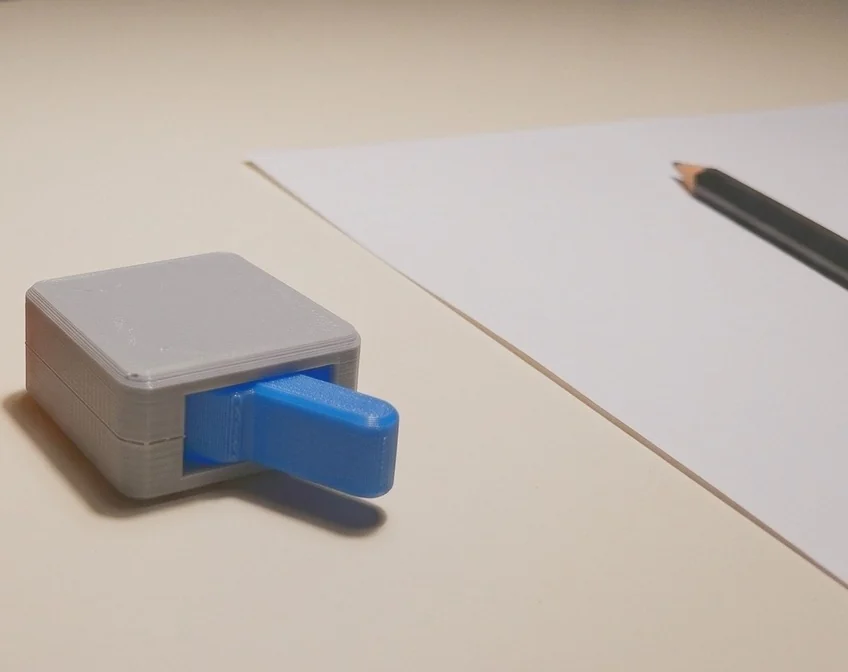
Use this sheet on paper. Nothing on this screen is sent anywhere, and there is nothing to type into here. Print it, or copy the rows out by hand, then fill them in with a pencil, one row at a time. Rough drawing is fine, and so are blank boxes. The marked entries are one made-up example, a desk stand for a tablet. Answer the last row before you show the details to anyone.
1 Say what it is for
Write one sentence on what the thing must do, and one on what it must never do. The more a maker knows about how it will be used and what it connects to, the better the design can be. Then tick whether the first one should look right, work, or both.
2 Draw three views
Draw it from the front, from the side and from above, and draw the thing it holds or touches in dashed lines. Label each view. Nobody needs art here, only lines a stranger can follow.
3 Mark every size
Write a size only where you know it, and mark each one: exactly this, about this, or your choice. You do not need every number. A few clear sizes help more than a crowded page.
4 Show what it touches
Name the object it holds, sits on or fits into, and measure that object. A paper or cardboard stand-in, photographed beside a ruler or a coin, shows its size at a glance.
5 Say how many, and from what
Write how many you want first. One is a fine answer. Add any wish for the material, even “not sure”.
6 Before you share
Ask the questions in the last row in writing, and keep the answers, before you send any detail you would not show in public. If you plan to patent the idea, read the section on sharing below first. At LOUEI 3D PRINT, confidentiality and file ownership are agreed per project, in writing, on request.
What my sketch shows
Example, marked
1What it is for
It musthold a tablet upright while I tap the screen
It must nevertip over, or scratch the case
2Three views
Key: 1 slot, exactly this · 2 height, about this · 3 cable gap, about this · 4 base, your choice
3Every size, marked
| Size | My number | Mark |
|---|---|---|
| Slot | fits my case, measured 10 mm thick | exactly this |
| Height | about a phone’s length | about this |
| Base | none | your choice |
exactly this = must be this · about this = close is fine · your choice = the maker decides
4What it touches
It holds or touchesmy tablet in its case
- Ticked: Photo beside a ruler
- Ticked: cardboard stand-in
- Ticked: the tablet in the photo
5How many, what from
- Ticked: One
- a few
- more later
Material wishnot sure; must not scratch the case
6Before you share
- Asked in writing
- Ticked: kept confidential?
- Ticked: who owns the 3D model and files?
- Ticked: who else sees it?
- Planning a patent
- spoke to a registered patent agent
What my sketch shows · LOUEI 3D PRINT
What should your first prototype prove?
A first prototype should prove one thing, chosen before anything is made.
A looks-like prototype answers whether the shape, size and feel are right; a works-like prototype answers whether the mechanism does its job. Pick one, because the choice changes how the piece is made and what you judge it by.
Write that one question at the top of your sketch, for example “does it fit in a cup holder?” or “does the hinge stay open?”, so the maker knows what the piece is for. One build that tries to answer every question at once tends to be the costly one: prove the look and the function separately, then combine them.
Decide what the first one must prove
Do you need exact sizes on your sketch?
No: you need exact sizes only where the thing meets something else, and a mark on every other size that says how much it matters.
A hole for a bolt, a slot for a card or an opening for a cable must fit, so measure what goes into it and mark that size exactly this. Sizes that only set the look can be rough. Where you do not know a size yet, say so and write what limits it, so a guess is not mistaken for a decision. A coin or your hand drawn in beside the thing helps a stranger judge its size.
Apps that turn a picture into a 3D shape give an approximate shape, not sizes you can rely on; the sizes that must fit still need a person and a ruler.
| Mark | Use it for | Example on a sketch |
|---|---|---|
| Exactly this | A size that must meet something else: a hole for a bolt, a slot for a card, an opening for a cable | “Slot takes a bank card: exactly this” |
| About this | A size that sets the look or feel, where a little more or less is fine | “Handle about as long as my palm” |
| Your choice | A size nobody will see or touch, such as wall thickness or inside ribs | “Wall thickness: your choice” |
| Not known yet | A size you cannot measure yet; say what limits it | “Height not known: must fit under the shelf above” |
What happens after you send a sketch?
After you send a sketch to a shop that designs from sketches, expect questions first, then a 3D model to check, then a first piece and some changes.
Questions come first, because every sketch leaves gaps; plan for some back-and-forth. Then someone draws the 3D model. Some shops send pictures of it from several angles, with the key sizes marked, for you to approve before anything is printed. The first piece shows what to change; one shop says almost every project needs at least one round of changes.
At LOUEI 3D PRINT, an idea or a sketch is enough to begin with, and CAD design is part of the job. The price comes from the part (what it does, how it is made, the material and how many) and is confirmed before production. See how a project goes from a rough sketch to an approved plan.
Same idea, two sketches
Before you contact any shop
Have these ready. Any shop will ask for most of them.
- Photos: the whole part on plain paper, the same view with a ruler beside it, and the break up close.
- The sizes you can measure, and what the part fits onto or into.
- Where the part lives and what it does.
- How many you need.
- Any file or drawing you have, even an old one.
At LOUEI 3D PRINT you can start from anything: an idea, a sketch, a photo, CAD, measurements, the broken part itself or a previous order. We read STEP, STL, OBJ, IGES, DXF, PDF drawings and photographs.
When this is not a job for a shop
- A first prototype answers one question about shape or function; it is not proof that the final product is strong or safe. A realistic rendering does not show that a product has been built or tested, and some design services give no guidance on strength or safety at all.
- A printed prototype meant to hold food or drink carries no implied Canadian food-contact approval.
- One design service tells customers not to send images of someone else’s protected idea or part, so a copy of another product may be refused.
Some parts cannot be reproduced: parts that are badly damaged, parts with missing geometry, and parts that need a certification we do not hold.
Written by the LOUEI 3D PRINT team. LOUEI 3D PRINT makes custom and replacement parts: 3D scanning and reverse engineering, FDM and resin 3D printing, molding and casting. Serving North America.